My Create x Connect experience ~ turning the mirror back & joining the party.
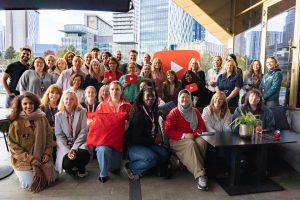
It’s the left-field, unlaboured opportunities that often carve out memorable shapes in life isn’t it? The oddities that fall into our laps with a ‘what the *****?’ moment before we recognise and nurture them. The training/talent development initiative I’ve just completed, courtesy of some serious convening from the BBC, YouTube and NFTS was just such an unexpected gift.
I made a blunt and swift application to the ‘Create x Connect’ programme in two spare hours of surviving unemployment and gun-slinging logistics for a flat clearance that hollowed me out in more ways than one. Between moving from my hard-earned rental near Richmond Bridge to my parents’ semi in Fleetwood, Lancs and an (inevitable?) return to London for work, I neatly slotted five remarkable months of training on that thing everyone thinks they know – the Creator Economy.
An all pervasive, constant channel that we rig ourselves up to, the act of listening to a spokesperson seems simple. Yet, we’ve barely got a handle on how this 21st century oratory is showing up on engineered platforms to influence: wellbeing, intelligence, productivity, globalism, human rights, politics of all kinds etc.
Over the last year, mainstream media has found more of a vertical for commentary from the defected architects of ‘digital’ who regret the speed with which big tech has pushed on like a giddy teenager, without due concern for human risk. And now the initiatives to mitigate stuff like disinformation, addiction, brainwashing, are becoming more visible across these engineered platforms themselves. I think it’s no accident that this wave of public narrative is taking place in 2026 – during the second term of President Trump, when the geopolitical power-balance has now shifted its tectonic plates in ways obvious to the casual consumer.
I’m not saying that this scheme I took part in touted itself as a tactic against disinformation…I think that learning to be a ‘Creator’ with journalistic integrity, while learning to bend content to fit an algorithm is quite reflective of an intermediate phase of growth in controlling the Mary Shelley monsters of Silicon Valley. This all sounds terribly hyperbolic, but I’m a poet as well as a journalist, and it’s important that some of us play with different names and framings for the AI we refer to with glib, jargon. Otherwise, how can we truly assess its place and value? Even asserting that we should assess it feels a little taboo.
Back to my ‘professional development.’ I applied for Create x Connect having suffered all the excruciating slings and arrows of the 2025/6 UK recruitment market for experienced middle managers. I wanted to see if I could gain more of an intuitive sense of what content travels. Sure, I can strategise across platforms, optimising their quirks, but I didn’t grow up with them like some of the Gen Z’s I’ve managed. I also immediately clocked the value of becoming fluent in YouTube.
YouTube’s got over 90% of the UK adult audience, and a share of the children’s audience in YouTube Kids. It’s among the top two video and audio platforms that people return to daily, and as you’ve probably realised – our elderly parents and grandparents are now habitually watching it on television screens with a degree of public service reverence. ‘Broadcast isn’t broadcast anymore.’ As a communicator with interests in factual storytelling and drama it made sense for me to hop on this bandwagon.
I’m not sure that it was explicit in the application’s advertising that the programme was designed to make ‘Creators’ of us, although questions around ‘how confident are you in making videos/reading analytics?’ were clues. So, there I was in May – someone who has spent the past eight years identifying the PR potential and positioning of others, gradually turning the mirror back on myself.
Back when I was building life around being an ‘Arts Council supported’ theatre writer-director (and the revolving door of part-time jobs that propped this up) I had a meeting with a regional venue manager following the R&D of a play. It was a strange meeting; he was visibly agitated for some obscure reason. With the benefit of hindsight, I can see that the conversation was about weighing-up the probability of future success as much as side-stepping investment from an overstretched enterprise. After some questions around what my Dad did, if my Mum worked, and how supportive they might be, we touched on marketing. (This is my pre re-entering the workplace as a PR.) I told him how I found it more difficult to ‘market myself’ – ‘You know how that sounds Tamsin?’ he said, as if intimating lack of confidence in myself or the work. I think we can all relate in having limited perspective on how ourselves and our personal work is perceived. Who really has an accurate idea of their schtick aged thirty? You’ve barely realised all the things that make you infuriated.
This question of schtick relates to a word used a lot when the Heads of Digital shared cutting-edge insights from ‘the platform,’ its evolving developments and audiences – ‘authenticity.’ Afterall, shtick is a curated version of a real person’s aspects and YouTube is a box that frames them. Weirdly, these months of playing around with being myself in scrappy test videos, sans kit, revealed a few things about my own selling points that were opaque to me – I still have a childish sense of enthusiasm about mundane activities that transport a person. Deeper than this, I kept naturally turning to the subject of concrete culture – i.e. the objects connected to stories in history and literature. I currently have an itch to make a video about Turner’s love of telescopes and Agatha Christie’s tools and itineraries on her archaeological digs, for example. I found surprising comfort in these objects as subject matter distinctly separate from all forms of other work. They are small portals of escape.
This isn’t where the process started – I was selected among fifty journalists from within and without Auntie Beeb for the News Strand – ‘trusted storytelling for the next generation.’ Somewhere in the journey, quick editorial decisions made for true ones – similarly to acting. My ex Mountview tutor’s line ‘make a f***ing choice’ could be amply applied to setting-up YouTube content for success – explain what you’re about to share in 30 secs, unpack in illustrative segments with hooks, employ economic scripting and ‘personality.’ I’m happy to let the ghosts of personal brand discoveries lie now…until they naturally burst forth like Vimto from an shaken can.
‘The platform,’ it’s reiterated to us, is a democratic space for all enthusiasts and hobbyists as much as broadcasters looking to ‘meet the audience where they are’ with products of public service – news, documentaries, education. The question of how democratic an algorithm that favours picture quality and specific formatting is, would make for an interesting university debate.
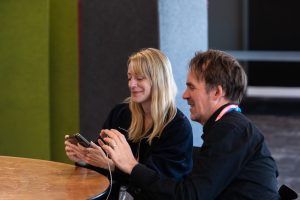
As the Tuesday webinars and masterclasses rolled on, some of us were tugged between the prospect of launching a self-sufficient initiative, with the prospect of broadening visibility and opportunities, and meditating on the realities of running a channel. Because there’s very little that’s really simple about the Creator Economy – hitting an audience sweet spot that intersects topic, aesthetics, personality and algorithm friendly formatting takes planning, time and resource as with any studio or newsroom. The wisdom in just ‘keep posting,’ will (unless you are one of the few that strike viral gold) only take you so far in numbers. I’m convinced that a one-person band needs to assume razor focus to make a channel reap commercial rewards through…advertising revenue, Memberships, brand deals…this takes a luxury of spare time and reflection to develop.
And the analytics show that the biggest tick-box is…consistency. Subscribers deal in loyalty, which is earned through…consistency of posting, content, quality…unless you have a wild-card channel that makes evergreen content which thousands consume only once. We encountered one such channel that featured encounters with rare beasts on outward bound holidays.

The unpicking of audience preferences through the stats is moreish…it adds an element of psychological detective work that cannot be applied to the preferences of the algorithm itself. My experience of communications campaigns sits snuggly with this kind of busy work. My capabilities in providing the level of sound/video editing and outsourced graphic design needed to lift my work off the screen and feed the algorithm is less certain. However, one of the principles of the Create x Connect community is ‘test and learn’ – the virtue of making a mess before cleaning it up.
Another principle is…giving networking its due respect. It appears that British journalists are more ‘British’ than journalists – in the sense that it takes my cohort several months to ‘warm up’ and start initiating break-out meetings from the group-chat. Even a dedicated online networking session of offers and barters attracts merely a few participants over the summer. With a healthy selection of producers and story editors in the room, I am personally lapping the experience up. Perhaps the truly cool ones are in Mykonos and don’t need new professional friends.
The scheme’s ‘connect’ days more than make up for this social sluggishness and are really a monument to facilitated socialising…half of each day is dedicated to the power of drinks and nibbles…with a special shout out for the YouTube puns served on the menu. The YouTube ‘shorts’ certainly have safety controls as they are low in alcoholic content…
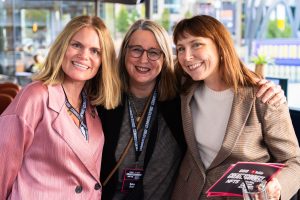
These nibbly bits were the real revelation to me. I think there’s an unspoken myth among those who have ‘grown up’ in the subsidised live arts bubble that in-house broadcast managers/commissioners occupy a rarefied common room, in the stench of designer swag, while being casual with celebrities. I mean, there’s a small element of truth in this and also there’s nothing wrong with it. But I don’t subscribe to this level of othering
…granted, there is a psychological wall of access built through the BBC’s competitive submissions processes – to talent development initiatives, incubators and training schemes. Floating around the bar by the water on Salford Quays, I was uplifted by how interested and generous with time the scattering of Auntie employees, across teams, were. Which leaves me with one very non-technical take-away – even if you haven’t found exactly the right platform, sometimes it’s just a case of finding the right party.
With thanks to Anna, Rhiannon, Mhari and all the brilliant women who rolled out this programme, which had real scope, including a gob-smacking amount of access to expertise.
TF