Dance review: The lost Breath x Jaikur – invoking ancestry at The Place
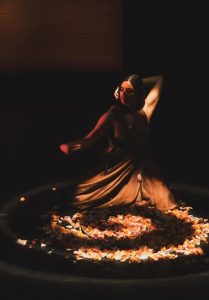
Photo by Pepe Gavilondo

We could all do with a large dose of the primordial – conflicts, cost of living and the lure of attention-grabbing from devices has made the hybrid world a fractious place to be – which is why seeing a piece of Indian dance like Kesha Raithatha’s ‘The Lost Breath’ is a welcome tonic.
Strongly leaning into themes of mysticism and ancestry, Raithatha starts as she means to go on by playing with simple and purist elements – she dances with her shadow, interacts with a spiral on the ground, a symbol associated with continuity, transformation and Goddess energy across traditions. She also relates to bodyless figures, outlined in hooded garments and moved from above to suggest forebears who act as witnesses.
The dance language is fluent in absorbing the human manners of Kathak and aspects of flow and floor-work from Contemporary, and the seamlessness with which these are blended is beautiful to observe. It is refreshing to see a piece of choreography that does not rely on extremes and athletics, so much as the inferences of defined actions, not unlike sign-language.
Signer, Hahna Ahmed, unobtrusively enters the stage when VO poetry is heard. The word-imagery is broad and centres around lineage and the female experience. However, the phrase, ‘We must acknowledge that we forget’ is memorable in driving home the message of reconnecting with one’s maternal history in the present.
I was intrigued to watch Jaikur, the film presentation, ‘invoked’ from The Last Breath, in the second part of the programme. Meaning ‘victory’ or ‘celebration’, or a combination of both, the film is an extension of the show, foregrounding the bodies, movements and expressions of female elders within the South Asian and Asian-African community in Belgrave, Leicester.
Jaikur, similarly to the show, takes a sweeping arial view, showing the women, from above and below, in unharvested fields and the outdoor spaces of Belgrave, Leicester– a park, communal benches, narrow Victorian terrace rows and the doorsteps of mini-markets. We also see the women dancing inside of a communal hall. They are captured with grace, sensitivity and a sense of joy in being ‘seen.’ This is the lingering comment of one participant in the after-show panel – that she began viewing herself more as an individual with a unique role to play, through the process.
Most impactful, was the contrast between the colour and vibrancy of the women, the expansiveness of the green fields – presumably evoking plantations in South Asia – and the implacable, uniform coolness of Leicester’s industrial backstreets. I know something of these terrace rows; my parents and three of my grandparents grew up in them. My father worked as a Junior in the advertising department of The British United Shoe Machinery Company on Belgrave Rd. in 1969.
The evolution of a specific geography from housing almost entirely working-class white families to almost entirely South Asian families from a continent of heat, colour, and differing religious traditions and music/dance rituals, is nothing short of a slow-moving phenomenon that raises so many questions about the highs and lows of lived experience.
While both Raithatha’s solo and the film stay close to the principles of dance as visual and visceral form of storytelling, they left me wanting to scratch below the surface of the lives presented and the specific nature of their connection to the past.
This enjoyable offering, commissioned by The Curve and Sadler’s Wells, has given visibility and an aesthetic window into the experience of South Asian women living in the Midlands. But, in light of the interviews gathered to inform the project, I was left wanting to know more.
TF