Heated Exchange? Can solar expansion benefit Northern communities?
Heated Exchange? Can solar expansion benefit Northern communities?
(for the NCTJ accreditation assessment 22/7/26)
Trampling a hazardous footpath along the third field on my route, I am disheartened to be met with another ‘Private property, no entrance’ sign.
I don’t know why I am surprised that it is difficult to gain an elevated view of one of the large solar farms springing up in the North of England. On one hand, the sites are owned by farmers or developers with discreet estates, off the beaten track. On the other, these sites now represent the dawn of a, potentially, contentious era for UK infrastructure.
At the end of 2025, the Planning and Infrastructure Act ushered in a bold approach to expediting how our green energy system is built, as a direct result of a pledge made when Labour came into power. In total, the 100-page plus document seeks to ‘streamline planning’ processes, ‘reform environmental assessments’ and seemingly push-along the delivery of a robust and ‘clean’ UK infrastructure, as supported by Great British Energy.
Having staked its claim in making the UK a turbine powerhouse through the fast roll-out of windfarms in 2024/25, the government’s solar power expansion is now gathering pace towards the Midlands and the North, and is becoming increasingly visible to interested parties. Approximately 300 grid-scale solar farms are currently in planning funnels across the North of England, according to Solar info’ UK, with an intensification of applications resting with councils in Yorkshire, East Riding and the Humber and North Lincolnshire.
This is perfect timing for our Northern Prime Minister’s rhetoric on re-industrialising northern hubs through global sectors like: advanced manufacturing, life sciences, digital, low carbon, and green technology. But does solar have the potential to re-energize rural communities in places like East Riding and North Kesteven? Or does the ambition for ‘growth in every post-code’ come with caveats?
The ‘Act’ doesn’t operate alone – it is paired with The Clean Energy Jobs Plan (Oct 2025), which aims to support regional economic regeneration, not only by creating jobs in construction, but by sowing seeds of a new, domestic supply chain for renewable energy. Campaigners such as George McManus of East Riding Against Solar Expansion are sceptical. McManus says:
‘New energy jobs are much more likely to be in the towns and cities rather than in agricultural areas themselves
…It’s very difficult to train people who have been very much used to arable farming or livestock farming in this area to work as instrument technicians or to work in the electronics industry. I don’t think it’s going to be anywhere near as significant as the thousands and thousands of jobs that are going to be created in places like China.’
McManus’ anxiety is also derived from the fact that many tenant farmers have had to abandon land assigned for solar farm projects, especially for the larger ‘Nationally Significant Infrastructure Projects’ that industrialize rural landscapes. He says:
‘People and families who still live in these businesses are going to have their quality of life totally destroyed.’
A spokesperson for the Department for Energy Security and Net Zero said: ‘Where solar projects are being considered on tenanted land, the landlord must respect the terms of the tenancy agreement and compensate them fairly for any loss of land.’
However, it is arguable whether fair compensation can be given for displacement, where ancestral roots are at stake. For those who have access, looking to apply specialist skillsets or retrain, The Solar Roadmap claims that 35,000 jobs directly and indirectly related to the energy transition will be generated by 2030. Some twenty thousand of these are expected to be created in Yorkshire and the Humber.
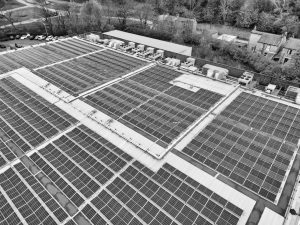
(Solar farm site near Bradford.)
Aside from familial ties and countryside traditions, groups within ERASE and organisations such as Campaign to Protect Rural England also feel a strong affinity with the food-security argument. With an estimated 40% of our food imported from other countries McManus says: ‘Some of the best and most fertile and versatile land is being used for these sites…and we don’t think we should sacrifice food security for energy security.’ Yet, the DESNZ is unequivocal in stating that the ‘biggest threat to agriculture is the climate crisis’ with Tom Bradshaw of the National Farmers Union concurring. He says: ‘it is important that we’re not sensationalist about the impact” when it comes to food security.’
Another enduring point of consternation is the efficacy of biodiversity and how it is monitored. Currently, the government stipulates that sites are expected to improve the BNG (Biodiversity Net Gain) of the land with a 10% uptick from its previous use. Adhering to a ‘Baseline Habitat Survey’ and demonstrating commitments to aspects such as ‘wildlife corridors,’ ‘rich grassland,’ and avoiding ‘high value habitats’ are part of this.
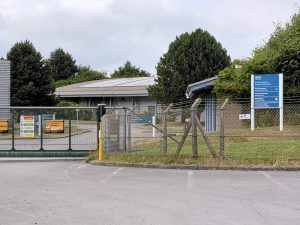 (A solar farm in Fleetwood Lancs’ has been mounted on top of the waste water works site.)
An approved solar site and NSIP at Clifton Marsh near Preston will constitute the size of ‘100 football pitches’ and provide electricity for an estimated 14,000 homes. Of its biodiversity plans, a spokesperson said:
‘The project has been designed to support energy generation and nature, creating habitats which will support a wide variety of wildlife. Grassland beneath the solar panels, combined with sheep grazing and improved drainage, will help reduce flood risk.’
Yet, many campaigners feel there is a gap between guidance in nature conservation and cultivation, and application. One stand-out change within the Planning and Infrastructure Act is that NSIPs producing over 100 MW of solar power will no longer be subject to ‘Section 42’ consultations, meaning that developers are not legally obliged to hold a community consultation process including stakeholders such as local bodies, authorities and landowners, although East Riding Council has iterated a commitment to gathering local evidence. A spokesperson said:
‘The Council responds to consultations on nationally significant infrastructure projects and considers the potential social, economic and environmental impacts of each proposal on its individual merits.’
Active facebook groups such as ‘North Yorkshire Against Light Valley Solar’ successfully paint a picture of ‘visual impact’ where large scale solar farms are concerned saying that: ‘rows of industrial panels will forever change our beautiful rural views, and the community that goes with it of local walkers, runners, families, dog walkers and horse riders.’
Though the efficacy of the government’s employability and biodiversity plans for solar in the North remain unclear, the arguments on both sides are compellingly passionate. Perhaps what is left is not so much a debate of two perspectives, so much as a crisis in communication…the one undeniable fact remains – that the expansion of solar has the capacity to produce 40GW by 2030 in a fierce bid to save people and planet.
TF