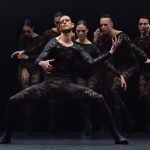
Dance review: The Red Shoes – a world of mid-century entertainment and vanity
Credit: Johan Persson

A ballet within a drama is a weird trope of post-war cinema that, thanks to Christmas TV programming, has dug firm roots into our collective imagination, with films such as The Red Shoes (1948), Carousel (1956) and An American in Paris (1951) lingering in the collections of Boomers and Millennials alike.
That potent fifteen years between 1945-1960 not only saw an energetic conflation of cultural influences thrown into films, with emigré talents such as Emeric Pressberger and Alexander Korda collaborating, but it was also a golden era for the evolution of ballet as an export to the western world. In this sense, Matthew Bourne’s The Red Shoes was always tipped to be a winner – blessed with existing rich media to adapt for the stage and a close thematic investment, that only a dance company could make.
Added to this mix is the extra syrup of meta-theatricality, which the 1948 film achieves by hopping in and out of realistic (although uncanny) and surreal scenes, and Bourne’s show achieves by hopping in and out of two heightened visions of theatrical reality. This could be fertile ground for confusion, but the production works primarily because of clear storytelling that can be followed by adults and children.
Elegant design by Lez Brotherston evokes technicolour and places a proscenium arch within the set itself, rotating to form the doorway between realities – a satisfying dance to watch. The dancers further create the environments of rehearsal rooms, Monte Carlo, tour digs as much as any prop paraphernalia, which is credit to the strong ensemble of distinctive personalities who blend physical theatre with choreography.
Cordelia Braithwaite is sympathetic as Victoria Page – the young ballerina torn between her profession, as epitomized by ‘the red shoes,’ and her lover, resulting in poetic tragedy. The original film by eccentric British powerhouse Powell and Pressburger/The Archers is based on a Danish folktale of vanity, obsession and redemption. It is intriguing to see these tensions played out as a reflection of the struggle female dancers faced in the 1940s. Before Moira Shearer, the Royal Ballet soloist who starred in the Film, marrying and having children while maintaining a ballet career was almost unheard of. Ironic then, that the silver-screen’s ‘Vicky Page’ should blaze that trail, which broke an unspoken rule among the evolving Royal Ballet company.
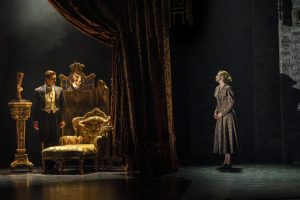
Andy Monaghan & Cordelia Braithwaite. (Credit: Johan Persson)
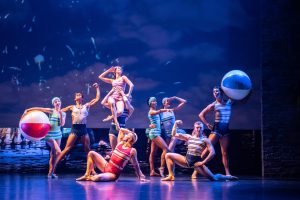
Interestingly, the technical performances that stand-out in Bourne’s Sadler’s Wells production are among the men…who showcase particular strength and aplomb during the seaside scene in Monte Carlo, echoing the athletics humour in The Ballet Russes’ Les Bitches of 1924 – also premiered in Monte Carlo.
There are beautifully rendered pas de deux of lyrical and emotional dimensions – notably between Vicky and Lermontov (Andy Monaghan) as the impresario makes her see herself in a new light.
As touted, the show is a valentine to dance with historic references sprinkled in the depiction of an impresario akin to Serge Diaghilev – aristocratic founder of The Ballet Russes and ‘Irina’ the Pavlova/Ulanova pastiche of a 1930’s prima played by Michela Meazza. A scene in which Lermontov prowls around his gold embellished hotel suite, clasping a statue of a golden foot in a ballet slipper sticks to the mind.
As with New Adventures’ Cinderella, Bourne’s The Red Shoes captures the gilded spit and saw-dust glamour of the mid-20th Century through an irresistible cocktail of smoke, mirrors and exquisite AV. The desolate vision of a European cityscape in the ballet within a ballet, as animated with a shower of crows and a company of partnering dancers is a joy. Bernard Herman’s film music serves this lush aesthetic, which gives the production all the appeal of a musical minus singing.
My only reservation to full-blown, melodramatic gushing is a lost opportunity for more tension. At the climax of piece, the: before, during and after of Vicky’s tragedy happens within a blink. This skating over the story’s central irony and ‘pointe’ speeds along with the music but isn’t unravelled.
However, this leaves us in a show that phenomenally realises a world of entertainment and vanity, while carrying us over dark moments of obsession with true mid-century style.
TF