Opinion: Timothée Chalamet’s remarks were a good thing for ballet & opera – and he has pointes…
Let’s lay down a disclaimer from the off – I am not a huge Timothée Chalamet fan. This defence is not coming from a position of studying his cheekbones with lust so much as a looking at one of my own communities from different angles.
I’ve come to know the live arts scene intimately, from developing theatre through Arts Council funding, to co-producing it, critiquing it and partnering with it from inside the commercial public relations engine.
When the sub-tribes of ballet and opera: education, production and above-the-line talent shared well contrived expressions of outrage at Timothée‘s faux pas, it was unsurprising for everyone.
The live arts, and I speak from a desk in the UK, is an attention-seeking beast that loves to assert itself in the chamber of voices that might diminish it – in any way…financially, socially. If there is genuine injustice or illegality in question – boy, you’d better avoid the wrath of grassroots performing artists for whom social-justice rhetoric is part of the informal training.
In this sense, ‘the Chalamet’ fed prime, rare meat (or protein substitute) to a very hungry lion. Not only did the beast have a golden opportunity to stand proudly on its hind legs and say ‘this is I!’ but it had the opportunity to do so in solidarity with other cats and go viral – online solidarity being another favoured activity of the subsidised arts scene.
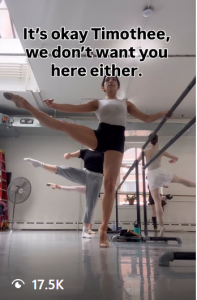
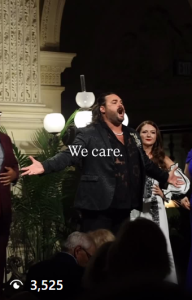
Just to isolate the offense from its virtual ocean of responses – what did he do exactly?
Well, the comment was made during a ‘Town Hall’ chat at the University of Texas, hosted by celebrity Lecturer, Matthew McConaughey for Variety and CNN. Curated questions were asked by the student body and both Matthew and Timothée exhibited a strong bromance that originated with their work on the film Interstellar and was baked in southern charm from both sides.
On broaching the durational changes in long-form cinema and the changing attention spans of casual and dedicated audiences, Timothée riffs on how industry voices say ‘we gotta’ keep movie theatre’s alive; we gotta’ keep this genre alive.’ He then reflects that people will go out of their way to see movies like Barbie and Oppenheimer, defying the common line on the diminishing attention spans of audiences…It’s at this point that he provocatively inserts:
‘I don’t want to be working in ballet or opera, where it’s like ‘hey’ we gotta’ keep this thing alive…even though it’s like, no one cares about it anymore.’
From a factual angle he’s not half wrong. According to Public First, around 19% of the British public consider Opera ‘unconventional’ while around 72% consider it ‘traditional.’
In a civilisation that has always valued the new and novel highly, from the Renaissance, to the Enlightenment and the age of AI, it makes perfect sense that an average of approx. 30% of people, across each region, have ever attended an opera, and only 9% of Brits believe it is ‘exciting.’ Over 40% of respondents aged 25-34 said they would see a work of opera based on a modern work of fiction like Harry Potter. In harmony with the sentiment above, You Gov stats’ suggest that a meagre 7% of UK adults attend opera at least once a year.
Predictably, Public First says there is a significant group that has ‘no touch point with Opera at all.’ Take the seaside town of Fleetwood, Lancashire, where my parents now live. The only venue that might host opera within reachable radius is Blackpool Opera House, which is more likely to programme Jane MacDonald’s ‘Living the Dream‘ and Strictly Come Dancing Live than a full-scale opera. Indeed, the deeply rural pocket of Rutland, where I grew up, only served up opera in the form of amateur enthusiasm and I was, at times, quite put off.
Ballet is a slightly different roaring beast because it has long been the extra-curricular of (and I’m aware of growing gender diversity) little girls in all counties and countries. In 2024, UK Google searches for ‘ballet classes near me’ reached 11,950. Yet despite that, the Arts Council’s Taking Park survey describes as little as 4% of adults in the UK attending ballet at least once a year.
So, the glib assertion ‘like, no one cares about it’ is – if the opera and dance industries search their souls and reporting – not coming from the tumble-weed of nowhere. It is a generalisation in relative terms. But like most things Timothée says in this interview, he has a point. This thirty-year-old man, who got very lucky, very young, is not inarticulate or unintelligent.
A stubborn knuckle of truth also lies in his reference to keeping genres alive. By definition, ballet and opera are revival genres. Yes, new works are commissioned. For dance these more often than not spill over into a new genre, that of ‘contemporary dance.’ But most two-three act ballet offerings are reimagined versions of eighteenth, nineteenth, early twentieth century creations by modernizers who trail-blazed in their own times – Ashton, Balanchine, Petipa. Equally, Musical America proffers that 75% of operas produced now, were conceived between 1835 and 1910.
The fact is that while film and TV are delivering sexy new storylines across a slate of genres and sub-genres…rom-com, fantasy, superhero, coming of age, crime, thriller, horror, relationship saga etc. Opera and ballet are, in the main, telling the same compendium of stories, often reserved for the once yearly treat of the middle-classes.
Timothée’s provocative chin-stroker of a comment throws down the gauntlet of ‘make me care’ to niche industries that have long been working on this challenge through ticketing strategies and outreach. Helping an arts promoter to put a finger on their own nose, shouldn’t necessarily be taboo.
And forgive my communications geekhood, but Marty Supreme’s ambitious ‘poke,’ prompted an exponential spike for ballet and opera’s share-of-voice in the global ELM conversation – an estimated increase of up to 25% within culture and arts coverage, in the run-up to The Oscars.
Here is where the actor’s public persona as a winning provocateur feeds in, like osmosis, to the backlash. The entire CNN interview embraced his ability and aspiration to ‘disrupt,’ and ‘push the envelope against the institution,’ while holding true to what is popular and resonates with himself and others, like movies and wrestling. The reverence with which he regales Matthew’s approach to acting at the interview’s outset cannot go un-noted – ‘Your respect for the filmmaking process…how seriously (you) took work.’
Admittedly, this commitment to mass culture may seem staged, given his up-bringing among New York creatives and intellectuals – his uncle is a Harvard educated Filmmaker and Actor. Although this could smack of reversed snobbery, Timothée is consistent. In his own words – ‘every incentive (in his industry) is to move in fear; I want to move in confidence and joy.’ This was exquisitely demonstrated by his cheeky pas-de-chats and tendus on The Oscars’ red carpet.
And considering he has raised some valid points, while providing an arena for Opera and Ballet to confidently charge into, (including the Oscars’ stage), who could deny him?
TF